
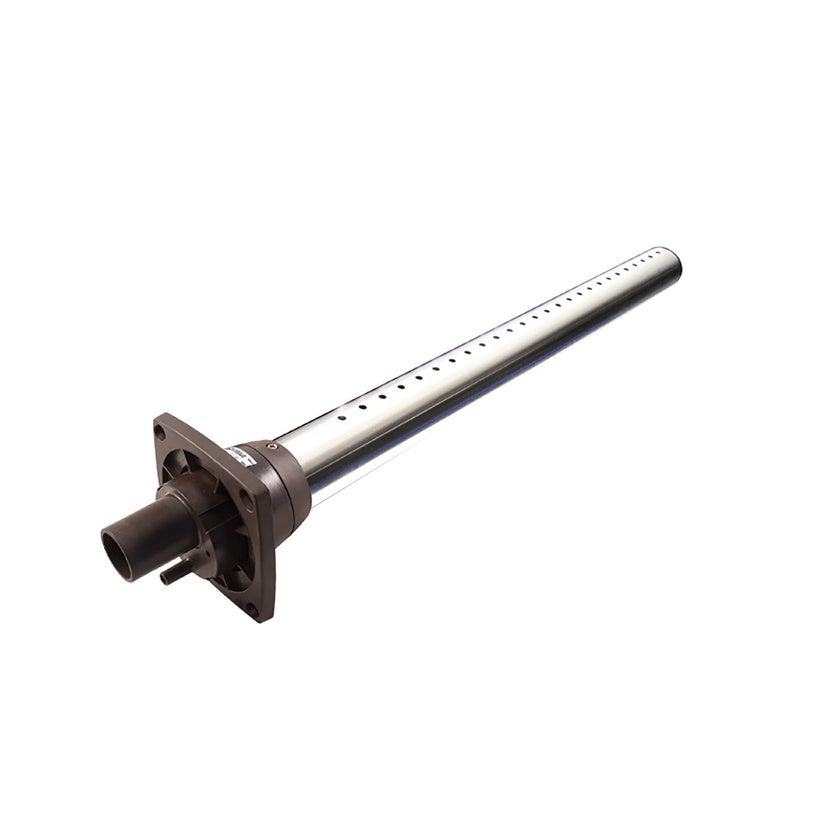
DP-series steam distributors
Main features
• Linear steam distributor for duct installation
• Designed for ventilation ducts and air handling units (AHU)
• Provides uniform steam distribution across the duct cross-section
• Short absorption distance
• Integrated condensate connection reduces condensation and prevents dripping
• Manufactured from stainless steel for long service life
• Available in several lengths and connection sizes
• Can be combined with multiple steam distributors for higher capacities
Description
CAREL DP-series linear steam distributors are designed for the distribution of atmospheric steam in ventilation ducts and air handling units (AHUs). They are intended for use with isothermal steam humidifiers and provide uniform steam distribution in the air stream with a short absorption distance and reduced risk of condensation.
Applications
• Ventilation ducts
• Air handling units (AHUs)
• Comfort humidification
• Industrial humidification systems
• Commercial buildings
Capacities
• The DP-series covers a wide capacity range and is selected based on:
– Humidifier steam capacity
– Duct dimensions
– Required absorption distance
• Multiple steam distributors can be installed in parallel for higher capacities.
Product selection
• Model selection is based on duct height and required steam distribution capacity.
• Available in lengths from 350 to 2050 mm.
• Diameters of Ø35/45/60 mm (for Ø22/30/40 mm hose).
• See document +800003001 Product Guide for available variants.
Accessories
• Flanges
• Steam hoses
• Condensate hoses
• Distribution pipes
• Mounting accessories
• The DP steam distributor is installed directly in the ventilation duct or air handling unit.
• Model and length selection is based on duct dimensions, steam capacity and required absorption distance.
• The steam distributor is connected to the humidifier via steam hose or steam piping, together with a condensate drain connection.
• For optimum performance, recommended straight duct lengths and minimum distances to bends, filters, cooling coils and sensors must be observed.
-
CAREL_(+800003001_01.03.2026)_humidifers-product-guide-EN (8,446 kB)BrochureEN2026-03-18
-
Luftbefuktare-KB_broschyr_2603-SE (6,024 kB)BrochureSE2026-03-13
-
DP-linear_steam_distributor_(+050001110_11.01.2023)_datasheet-EN (275 kB)Technical Data SheetEN2026-03-17
-
humiSteam_(+3000095EN_16.12.2021)_brochure-EN (1,678 kB)BrochureEN2026-03-17
-
humiSteam-basic_(+0300042IE_28.06.2022)_manual-EN-IT (7,346 kB)Operating instructionsEN2026-03-17
-
humiSteam-basic_(+040000075_09.11.2009)_quickguide-EN (472 kB)Commissioning/MaintenanceEN2026-03-17
-
humiSteam-wellness_(+0300060EN_24.10.2025)_manual-EN (4,091 kB)Operating instructionsEN2026-03-17
-
humiSteam-wellness_(+3000096EN_28.10.2022)_brochure-EN (729 kB)BrochureEN2026-03-17
-
humiSteam-X-plus_(+0300040EN_13.10.2021)_manual-EN (3,798 kB)Operating instructionsEN2026-03-17
-
humiSteam-X-plus_(+0300040SV_13.02.2020)_manual-SE (3,503 kB)2026-03-17
-
heaterSteam_(+3000109EN_07.10.2024)_brochure-EN (2,026 kB)BrochureEN2026-03-17
-
heaterSteam-4_(+0300087EN_18.04.2025)_manual-EN (12,063 kB)Operating instructionsEN2026-03-17
-
heaterSteam-4_(+0300087SV_24.02.2023)_manual-SE (10,363 kB)Operating instructionsSE2026-03-17