
FabFlow™
Main features
• Textile system for indoor climate
• Draft-free ventilation with exceptionally low noise levels
• Selection of flexible and combinable air dispersion models
• Custom-designed for each unique project
Description
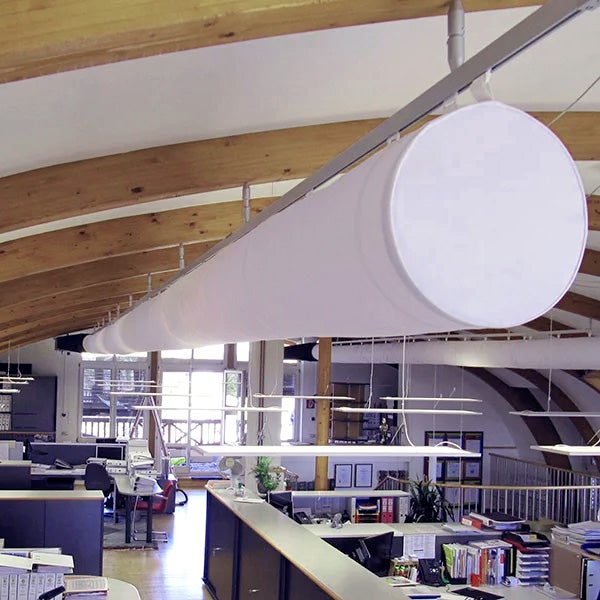
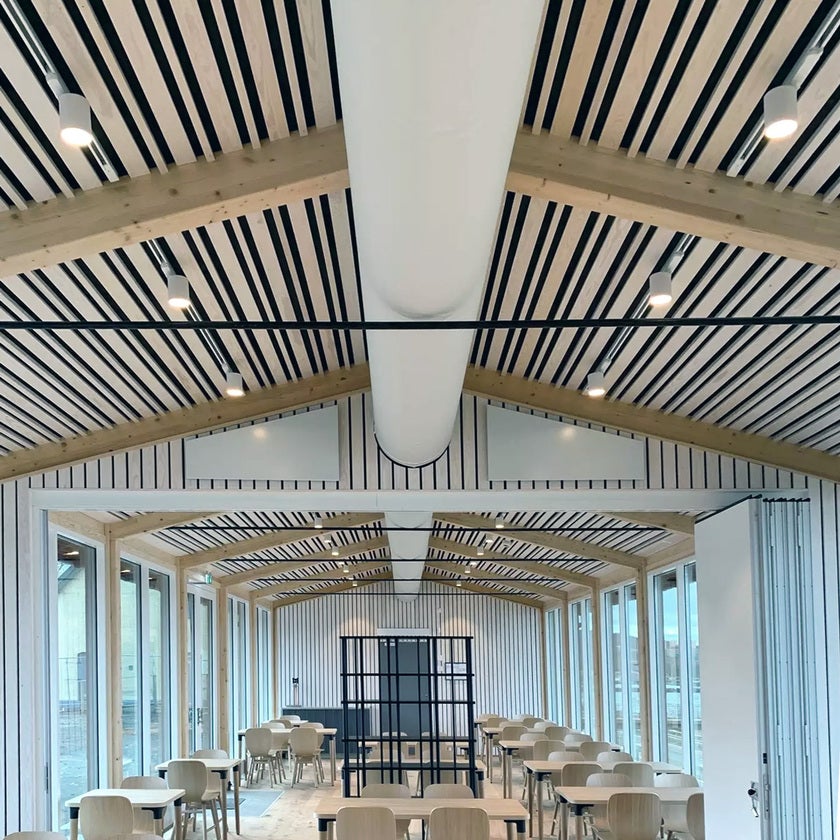
• Textile ventilation systems provide an environmentally friendly and cost-effective alternative to traditional metal ducting solutions.
• The FabricAir® textile system offer draft-free air distribution with very low sound levels, as the textile itself has natural attenuative properties.
• FabricAir® system solutions are custom-designed for each project. The layout is tailored to the unique conditions of each room, using a selection of flexible, combinable components to deliver an optimal indoor climate solution.
• The FabricAir® solutions are built from four core components, which can be combined in various ways to meet the specific requirements of each room:–
– Duct profiles: Used for both main ducting and diffuser sections. Available in five different profiles with additional options. Choice of profile depends on room dimensions, required airflow, and aesthetic preferences.
– Suspension systems: Can be used individually or combined to efficiently provide customized solutions for each installation.
– Textile types: Woven materials with different properties to meet common customer requirements, e.g., flame-retardant, antibacterial, or mold-resistant fabrics.
– Flow models: The basic properties of the textile are combined with laser-cut perforations or nozzles, which, depending on their placement and density, provide a variety of air injection principles and throw lengths. The system offers seven different air distribution models with varying distribution patterns and throw lengths, which can also be combined in hybrid solutions. Selecting the correct airflow pattern requires a thorough understanding of the space, particularly for applications designed to provide maximum comfort. In general, the airflow models are divided into two categories: diffusive (‘low-velocity’) and directional (‘high-velocity’).
• By combining the airflow models with the textile properties and remaining system components, while considering specific climate requirements and operational factors, each project is custom-designed to deliver the optimal indoor climate, meeting the unique needs of the customer. See Options and accessories for further details.
FabricAir® uses seven combinable air distribution models, which, together with the textile properties, provide a tailored indoor climate for all requirements.
Surface Flow – ‘low-velocity’ (secondary flow)
Surface flow models distribute the air through the surface of the duct either through permeable fabrics or microperforations covering a minimum of 25% of the surface. Surface flow technology is often used to prevent dust and other particles from accumulating inside or on the duct’s surface, making it virtually maintenance-free. Surface technology also prevents condensation from forming in or around the duct’s near zone. The FabricAir® textile system offer three surface flow models.
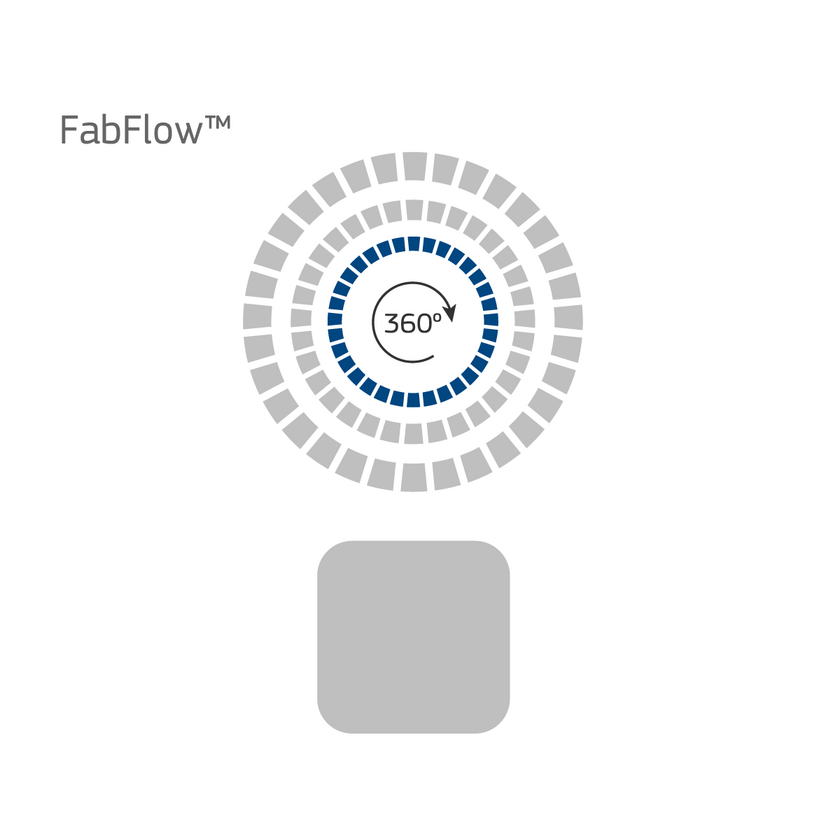
FabFlow™
• In FabFlow™ the air exits the duct through the permeable fabric surface. The air is driven by thermodynamic forces preventing drafts in the occupied zone, which results in a high level of comfort. FabFlow™ offers fully condensation-free air distribution.
MicroFlow™
• With MicroFlow™, the air exits the duct via laser-cut micro-perforations on a larger percentage of the duct’s surface area. MicroFlow™ has the smallest near-zone of all of the perforated fabrics available; the near-zone will not extend beyond 300 mm.
PerfoFlow™
• With PerfoFlow™ the air exits the duct via laser cut perforations along the circumference of the duct. The perforations cover between 90° and 360° of the duct’s circumference. The model enables distribution of large air volumes. It is effective air make-up in high ceiling industrial applications and replaces high levels of exhausted process air.
Directional Flow – ‘High-velocity’ (primary flow)
Directional flow models have a row or more of air distribution placed along the length of the duct at any desired position to deliver the air exactly where it is needed. FabricAir offers many air distribution types that can be combined as necessary to achieve the desired air distribution patterns. The FabricAir® textile system offer four directional flow models.
SonicFlow™
• SonicFlow™ is a directional flow model where the air exits the duct via rows of laser cut perforations. Multiple rows of SonicFlow™ can be specified for a duct, with each row covering a maximum of 30° of the circumference. The throw depends on the static pressure inside the duct, the size, and spacing of the perforations. The model is an efficient solution regardless of ceiling height.
OriFlow™
• OriFlow™ is a directional flow model where the air exits the duct via rows of laser-cut orifices. Multiple rows of OriFlow™ can be specified for a duct. The throw depends on the static pressure inside the duct, the size, and the spacing of the orifices. It is ideal for medium to high-velocity directional air and ensures heating in medium to high ceiling projects.
NozzFlow™
• NozzFlow™ is used in applications where very precise directional airflow is needed. The discharge coefficient is almost at unity due to the shape of the nozzle. This results in higher discharge velocities than an equivalently sized orifice, and longer more directional throws.
JetFlow™
• JetFlow™ generates exceptionally long throws through the use of conical jets in varying diameters. The jets have a very high discharge coefficient due to the conical shape, which results in higher discharge velocities than an equivalently sized orifice.
Combining flow models – Hybrid Flows
• FabricAir offers a wide variety of flow models that can be combined to create the ideal air distribution solution in any project.
• The ideal flow model often consists of primary and secondary airflows in a combination depending on throw requirements. The primary airflow addresses the main issue, such as no draft for increased comfort, whereas the secondary airflow is used to ensure that no condensation builds up on the duct in humid environments.
• It is of utmost importance to understand the type of space that is being designed in order to select the appropriate flow models, especially in applications that are intended to maximize occupant comfort.
Suspension system
• Suspension components – Wire suspension, including screws, brackets, and plastic-coated stainless steel wire locks.
• Wire suspension can also be supplied with galvanized components upon request.
• H-rail / T-rail in anodised aluminium.
Textile parts
• All FabricAir® Combi™ textiles are made of polyester, certified according to the following standards:
– Heat-resistancy and Fire safety classification according to EN 13501-1:2009.
– Fabric strength classification according to EN 13501-1:2009.
– Cleanroom classification according to ISO 14644-1.
– Environmental classification according to OEKO-TEX® 100.
– Shrinkage according to EN ISO 5077.
• Textile types Combi 80 and Combi feature antibacterial treatment according to ISO 20645.
Other details
• Remaining details are made of anodized aluminum with steel brackets, nuts and bolts, with plastic details from POM (acetal), e.g. slider fittings etc.
• Each delivery includes a modular assembly drawing prepared for the specific project and selected suspension type.
General delivery and Installation Overview
• FabricAir® textile systems are user-friendly and easy to install.
• The low material weights allows fast and simple installation, reducing assembly time and eliminating the need for special tools.
• Each delivery always includes a complete order summary, provided as a checklist together with relevant documents, e.g., installation guide, cleaning and maintenance manuals, and specification drawings.
• All boxes in the delivery are numbered according to the assembly sequence. The attached summary is always placed in the box marked “1”.
• Each textile section is labeled with a number tag containing key information, including duct dimensions, material type, washing instructions, flow model, delivery and component IDs, and numbering for correct assembly sequence. The numbering corresponds to the attached system drawing.
• Each duct section connects with a robust zipper, covered by an additional seam. This ensures both easy installation and maintenance.
• Painting is not required, as ducts are delivered in the pre-selected colour.
• Duct connections to metal components, e.g., air handling units, are secured with a durable fastening strap, always included in the delivery, further reducing installation costs.
• Installation of suspension types, consisting of wire and/or rail hangers, is as simple as hanging a shower curtain.
• Installation and suspension instructions are based on clock position orientation.
• For a more detailed description of suspension types, see the separate document FabricAir_Montageoversikt-SE.pdf (SE - Installation Overview) or the detailed installation instructions included with each delivery.
-
FabricAir_produktblad-SE (4,006 kB)Product sheetSE2026-04-24
-
FabricAir_DU-SE (982 kB)Commissioning/MaintenanceSE2026-04-24
-
FabricAir_Montageoversikt-SE (32,626 kB)Assembly/InstallationSE2024-08-06
-
FabricAir_BVD-BVB (57 kB)Building goods declarationSE2024-11-04
-
EPD_FabricAir-EN (1,766 kB)Environmental DeclarationEN2026-05-04
-
FabricAir_Warranty-EN (454 kB)Building goods declarationEN2024-11-04